Feasts of Israel – Feast of Trumpets (Yom Teruah)
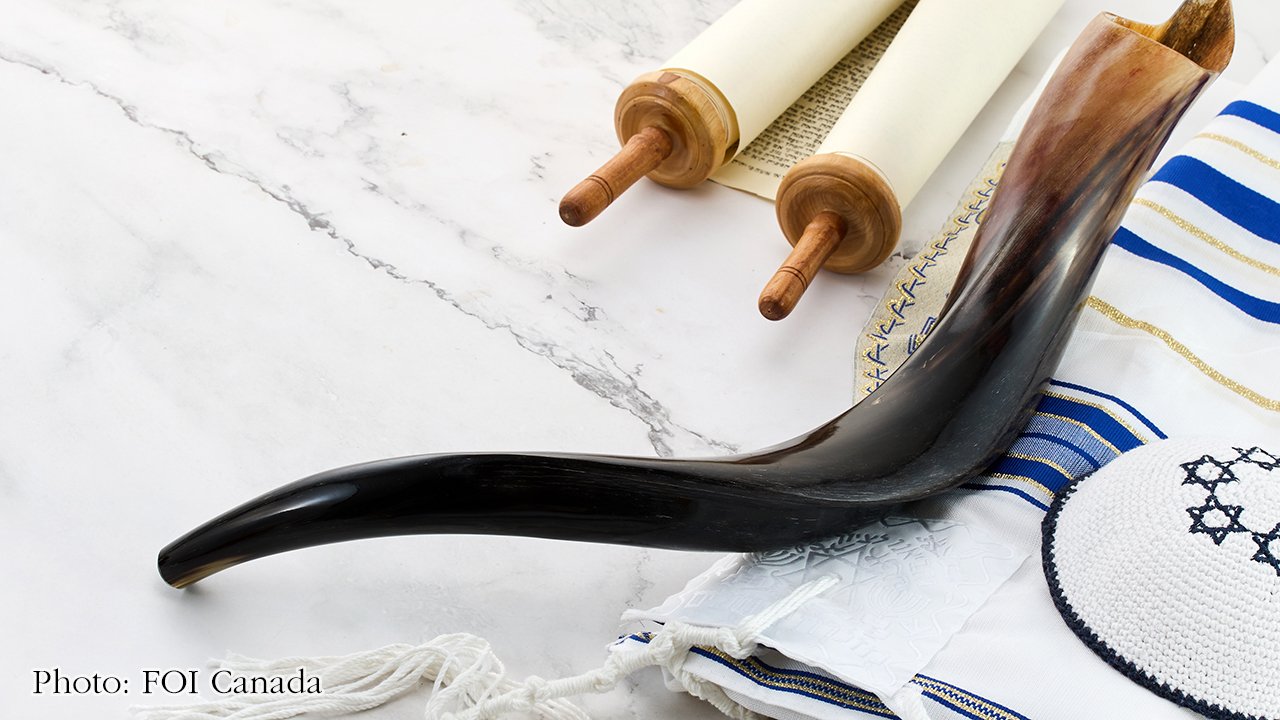
It was during the Walk with Israel in Toronto that I first heard the sound of the Shofar while in the company of Jewish people. It was being blown in an underpass very close to the start of the walk. Naturally the crowds cheered as they walked past. At least that is the way I, a Gentile supporter of Israel and the Jewish people saw it at the time.
In Leviticus 23 we read about the Sacred Occasions, Holy Convocations, Appointed Times, or Feasts (various terms used to translate from Hebrew into English) the Lord God instructed Moses to teach to the Israelite people.
One of those Appointed Times is known as The Feast of Trumpets (23:24-25). As a gentile, I think of a trumpet as a musical instrument made of metal. But for the Jewish people the word translated as trumpet is understood to be the shofar – a ram’s horn.
There are three instructions given for this Feast or Sacred Occasion:
a sabbath rest,
a memorial of blowing of trumpets,
a holy convocation.
Or as a Jewish author put it, “Rest, Remembrance i.e.: yom teru’ah / zikhron teru’ah (day/memorial of shofar blasts), Holy gathering with specified sacrifices.” [https://voices.sefaria.org/sheets/672984?lang=bi]
Numbers 29:1-6 records the instructions the Lord gave regarding the animal sacrifices that were to be made on that day.
There is one other passage in the Hebrew Scriptures that specifically mentions this Holy Day. It is found in the book of Nehemiah.
Nehemiah, who served as cupbearer to Artaxerxes the king of Persia, had received news that things were not going well in Jerusalem. “The survivors who have survived the captivity there in the province are in dire trouble and disgrace; Jerusalem’s wall is full of breaches, and its gates have been destroyed by fire.” [Nehemiah 1:3]
Nehemiah’s heart broke for the condition of his people and for the city of Jerusalem. He cried out to the Lord that he would be granted mercy in the sight of the king he served.
Long story short, King Artaxerxes appointed him Governor of the province of Judea and sent him with full military escort to the land. Once in Jerusalem, Nehemiah oversaw the rebuilding of the walls – in record time, even in times of distress. [Daniel 9:25]
The people were now starting to feel somewhat more secure in their homeland. “Then the seventh month came, and the sons of Israel [were] in their cities." [Nehemiah 7:73].
In Nehemiah 8:1-12, we read that these same people called upon Ezra and all the priests to teach them the book of the Law that had been found.
The response of the people to being taught from the Law of Moses was intriguing: “All the people were weeping when they heard the words of the law." [Nehemiah 8:9]
We are not told why, but their reaction may be a clue as to how this Feast may have a future/prophetic fulfillment. But first, let’s also consider how this Feast has transformed from its biblical roots into what it is today in Judaism.
The concept of Rosh Hashanah (literally “Head of the Year”) originated in Jewish Oral tradition. In Jewish tradition, Rosh Hashanah is less about celebration of the New Year ahead than about Judgement of the year now past. “All are judged on Rosh HaShana, and their sentence is sealed on Yom Kippur” [Rosh Hashanah 16a:6, The William Davidson Talmud, (Koren – Steinsaltz)]
The Babylonian Talmud goes on “to discuss the Day of Judgment... Three books are opened on Rosh HaShana... One of wholly wicked people, and one of wholly righteous people, and one of middling people whose good and bad deeds are equally balanced. Wholly righteous people are immediately written and sealed for life; wholly wicked people are immediately written and sealed for death; and middling people are left with their judgment suspended from Rosh HaShana until Yom Kippur, their fate remaining undecided. If they merit, through the good deeds and mitzvot that they perform during this period, they are written for life; if they do not so merit, they are written for death. [16b:12]
It is within this context of Judgment that the Shofar fits in. “The primary mitzva of Rosh HaShana, sounding the shofar.” [Mishnah Rosh Hashanah 3:2] A “mitzvah” is the combination of a good deed and a Jewish ritual commandment.
So for a Jewish person, living under the rules of Judaism, either blowing the Shofar or hearing the Shofar being blown will earn them merit points that will help ensure their name is “written and sealed for life.”
In another Jewish text we read, “the shofar blasts on Rosh HaShana... combines elements of remembrance, proclamation, warning, and majestic coronation.” [Introductions to the Babylonian Talmud, Rosh Hashanah, Introduction to Rosh Hashanah, (William Davidson Edition - English)]
There is something very special and awesome about hearing the Shofar being blown, that I as a gentile, will never fully comprehend.
With its focus on the Shofar, there are good Bible scholars who suggest that this Feast or Sacred Occassion has a prophetic connection to the Rapture of the Church. What if, instead, this is foreshadowing the Victorious Return of the Conquering Jewish Messiah?
For those Jewish people who will survive the devastation of the seven years of Tribulation, and cry out, "Blessed [be] he that cometh in the name of the LORD" (Psalm 118:26). This will indeed be a day of Rest.
It will also be a day of Remembrance: "And they shall look upon me whom they have pierced, and they shall mourn for him, as one mourneth for [his] only [son], and shall be in bitterness for him, as one that is in bitterness for [his] firstborn." [Zechariah 12:10]
Zechariah’s prophetic statement echoes the response of the people as recorded in Nehemiah when they wept and grieved when they heard the words of the law. [Nehemiah 8:9,11 KJV]
For those who reject the Jewish Messiah, this will also be a day of Judgement: "And it shall come to pass in that day, [that] I will seek to destroy all the nations that come against Jerusalem" [Zechariah 12:9 KJV]
“The shofar blasts on Rosh HaShana... combines elements of remembrance, proclamation, warning, and majestic coronation.” What a fitting way to proclaim the coming of the Jewish Messiah!